
Project for Privacy and Surveillance Accountability (PPSA)
  • Issues
  • Solutions
  • SCORECARD
    • Congressional Scorecard Rubric
  • News
  • About
  • TAKE ACTION
    • Section 702 Reform
    • PRESS Act
    • DONATE
  • Issues
  • Solutions
  • SCORECARD
    • Congressional Scorecard Rubric
  • News
  • About
  • TAKE ACTION
    • Section 702 Reform
    • PRESS Act
    • DONATE

 NEWS & UPDATES

Why Is the House Doubling Down on the Make Everyone a Spy Law?

12/2/2024


Expansive Spy Law Even Targets Churches

Picture
Breitbart recently broke a story that a few recalcitrant House Members are holding up a promised fix to what many referred to as the “Make Everyone a Spy” law.
 
The fix regards an amendment to the reauthorization of FISA Section 702, passed in April, in which pro-surveillance advocates added a requirement that U.S. business owners who offer customers the use of their Wi-Fi and routing equipment be covered as “electronic communication service providers” under the law. This means that any business – your neighborhood fitness center, an office complex that houses journalists, political campaigns, or even a church or other house of worship, as well as a host of other establishments – would face the same requirement as large telecoms to turn over the communications of their customers, no warrant required.
 
This was not meant to happen. As the Senate voted in April to reauthorize FISA Section 702, bipartisan furor erupted over this provision, including leading conservatives in both chambers. Sen. Mark Warner (D-VA), Chairman of the Senate Intelligence Committee, promised his colleagues that the amendment that included this expansive authority would be narrowed to include only one category of business. That category is classified but is widely believed to be data centers that provide cloud computing and storage.
 
With this promise in hand, the Senate voted down an amendment to remove the flawed provision, and immediately passed the reauthorization of Section 702 – all in the belief that the expansive new spy power would soon be curbed.
 
Sen. Warner was true to his word, inserting language into the Senate intelligence bill that narrows the scope of the new measure. Now, in a baffling turn of events, it is the House that is refusing to include the fix in its version of the intelligence bill.
 
Why are some House Members insisting on keeping an authority that allows spying on churchgoers, shoppers, and office workers? Bob Goodlatte, the former chairman of the House Judiciary Committee and PPSA senior policy advisor, told Breitbart News: 
 
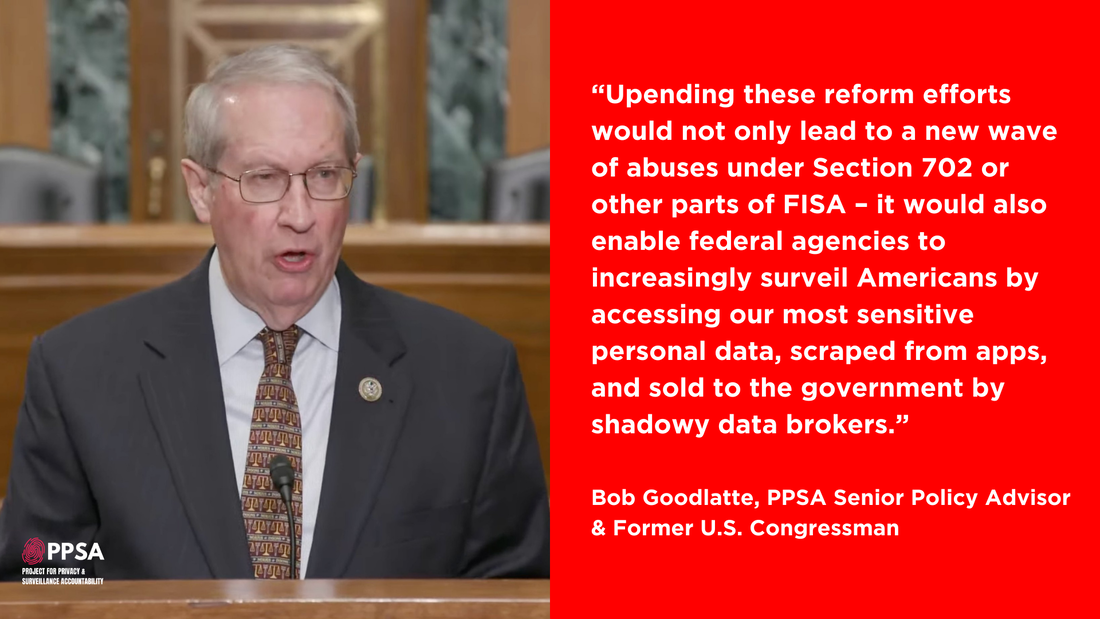
“This measure passed because of assurances that this insanely broad authority would be narrowed. The promise of a fix was made and accepted in good faith, but that promise is being trashed by advocates for greater surveillance of our citizens. Unless Congress reverses course, Americans’ data that runs through the Wi-Fi and servers of millions of small businesses, ranging from fitness centers to department stores, small office complexes, as well as churches and other houses of worship, will be fair game for warrantless review. This would truly transform our country into a thorough surveillance state. I can’t imagine the next Congress and new Administration would welcome that.”
 
Surely, giving the deep state free rein to spy on Americans is not in keeping with the philosophy of the incoming Trump administration, the new Republican majority in Congress, or most Democrats.
 
Contact your House Member and say:
 
“Please don’t let this legislative year end without narrowing the Electronic Communication Service Provider standard. Congress must keep its promise to fix the Make Everyone a Spy Law.”
CONTACT YOUR HOUSE MEMBER HERE

    OR HAVE US DO IT FOR YOU

TELL MY HOUSE MEMBER!

Congress – Keep Your Word on Fixing the “Make Everyone a Spy” Provision

11/14/2024

 
Picture
​The election may have shaken Washington, D.C., like a snow globe in the grip of a paint mixer, but the current Congress still has important business for the lame duck session. For anyone who cares about privacy in this age of surveillance, issue one has to be whether or not Congress will retain the promised fix to what so many call the “make everyone a spy” provision in the National Defense Authorization Act (NDAA).
 
This story goes back to April, when the House Permanent Select Committee on Intelligence slipped into the reauthorization of FISA Section 702 (which authorizes foreign intelligence) a measure to allow the government to secretly enlist almost every kind of U.S. business to spy on their customers. In response to the outcry, carveouts were made that exempted coffee shops, hotels, and a few other business categories. But most businesses – ranging from gyms to dentists’ offices, to commercial landlords with tenants that could include political campaigns or journalists – are required to turn over their customers’ communications that run on ordinary Wi-Fi systems.
 
It is widely believed that this legislation was aimed at cloud computing facilities, which were not previously covered by the relevant law. When the Senate took up reauthorization of Section 702, Intelligence Committee Chairman Mark Warner (D-VA) admitted to his colleagues that the new measure was overbroad, and that he would craft new legislation to fix it. Sen. Warner kept his word and crafted legislation to narrow the provision. Although the nature of this fix is classified, it is widely believed to limit this new surveillance power to cloud computing facilities.
 
The House Intelligence Committee, however, did not adopt that fix. We hear that behind-the-scenes negotiations are taking place, but we cannot report exactly who might be blocking it or why. Suffice it to say that it is far from clear that Congress will ultimately adopt Sen. Warner’s fix.
 
PPSA calls on Speaker Mike Johnson and Senate Minority Leader Mitch McConnell to make it clear that the NDAA will include a provision to narrow the scope of this extreme provision. We must not give the FBI and other government agencies warrantless access to practically all communications that run through any kind of equipment operated by almost any kind of business.
 
Allowing the current law to remain unfixed and unreformed would be a terrible punch in the gut to the American people and the new Congress. The 119th Congress has many surveillance debates scheduled, including one over the reauthorization of Section 702 itself in 2026 – which passed the House with the breaking of a tie vote. It would be a mistake to saddle the new Republican majority and the incoming Trump administration with a broken promise.
CONTACT YOUR MEMBER OF CONGRESS
SEE HOW YOUR REPRESENTATIVE SCORED ON PRIVACY ISSUES

    STAY UP TO DATE

Subscribe to Newsletter
DONATE & HELP US FIGHT FOR YOUR PRIVACY RIGHTS

Sen. Rick Scott Shows that Surveillance Reform Is Good Politics

11/13/2024

 
Picture
​Sen. Rick Scott – former two-term governor of Florida, now re-elected to the Senate by more than 10 points over his most recent challenger – has consistently voted for surveillance reform. Sen. Scott has been a vocal champion of reforming FISA Section 702 – enacted by Congress to authorize surveillance of foreign threats on foreign soil, but often used to collect the communications of Americans. Sen. Scott called FBI Director Christopher Wray on the carpet to tell him that he’s squandering the credibility of a great agency by playing games with Americans’ privacy.
 
Rick Scott has also been a strong supporter of a probable cause warrant requirement before the FBI and other intelligence agencies can review Americans’ personal data and communications. Such principled stands on surveillance reform explain why we gave the Florida senator an “A” rating in our PPSA Scorecard.
 
From Tallahassee to Capitol Hill, Sen. Scott has made winning tough races look easy. We encourage more Members of Congress in both parties to recognize what Sen. Scott demonstrates, that surveillance reform is good politics.

    STAY UP TO DATE

Subscribe to Newsletter
DONATE & HELP US FIGHT FOR YOUR PRIVACY RIGHTS

How the U.S. House Can Oversee the Agencies that Spy on It

11/11/2024

 
Picture
If you do not change direction, an ancient Chinese philosopher wrote, you might wind up where you were heading. Where we are heading is a U.S. House of Representatives that is charged by the Constitution with oversight of the executive branch intelligence community (IC), but in fact is a supervisor being overseen by the supervised.
 
Since 2020, PPSA has used every legal avenue from Freedom of Information Act requests to lawsuits to press the IC – the Department of Justice, the FBI, the Office of the Director of National Intelligence, the National Security Agency, and the Department of State – to provide records concerning the possible surveillance of 48 Members of Congress on committees of jurisdiction that oversee the intelligence community. We’ve reported on court revelations of warrantless intrusion into the personal communications or data of Rep. Darin LaHood (R-Ill), an unnamed U.S. senator, a state senator, and a state judge. When faced with queries and exposure, the government resorts to obfuscation and delaying tactics.
 
Even when it is Congress that is doing the overseeing, attempts to understand intelligence operations often amount to howling in the wind. Agencies sometimes don’t answer congressional queries with substantive responses, if they even bother to reply at all. 
 
The House of Representatives can address this upside-down oversight scheme with one simple stroke. The House Rules Committee will soon craft the new rules by which that body will deliberate during the 119th Congress. We call on the Rules Committee to adopt a new rule to allow every House Member to choose one staffer to be eligible for a Top Secret/Sensitive Compartmented Information (TS/SCI) security clearance.
 
Oversight falters because only a few Members have staffers with such clearances. Members without cleared staff are unable to ignore their other duties to spend long hours in a secure compartment leafing through hundreds of pages of classified reports. Without making cleared congressional aides eligible for TS/SCI clearances, most Members – even those serving on oversight committees like the House Judiciary Committee – will continue to lack a basic understanding of current intelligence agency practices. 
 
Worse, among the staffers who are cleared, some are “detailees” from the very agencies they are helping their Members to oversee. 
 
Defenders of the status quo will argue that expanding clearances in the House is a prohibitively dangerous idea. That assertion is laughable. The intelligence community itself extends an estimated 1.2 million top-secret security clearances to federal government employees and consultants. A few hundred more clearances for aides vetted by the FBI and serving Members accountable to the public would be a tiny addition to the current army of Americans with TS/SCI clearance. 
 
The Senate shows the House it doesn’t have to accept being supervised by the IC. In 2021, Senate Majority Leader Chuck Schumer took the bold step of allowing one top secret/sensitive clearance to be available for one personal aide per senator. The House can do the same. All that is needed to enhance House oversight is to make wider access to clearances part of the House Rules package for the 119th Congress that begins in January.
 
Go here to call or email and tell your U.S. House Representative – “Please support a new House rule that allows every House Member to have one staffer eligible for TS/SCI security clearance.”

    STAY UP TO DATE

Subscribe to Newsletter
DONATE & HELP US FIGHT FOR YOUR PRIVACY RIGHTS

Real Clear Investigations on Foreign Censorship and Its Effects Here at Home

10/16/2024

 
Picture
​An important analysis from Real Clear Investigations probes the extent to which censorship abroad threatens the First Amendment here at home. 
 
Writer Ben Weingarten asks whether foreign demands that domestic media companies operating abroad comply with those nations’ often far more censorial legal requirements will lead in turn to more censorship here at home. The preponderance of the evidence suggests bad news for fans of the First Amendment.
 
Weingarten points specifically to the European Union’s Digital Services Act, which imposes content moderation standards that far exceed what would be considered constitutional in the United States. For example, companies doing business in the EU must combat “illegal content online,” which includes the disfavored rhetoric like “illegal hate speech.”
 
Writes Weingarten:
 
“Platforms also must take ‘risk-based action,’ including undergoing independent audits to combat ‘disinformation or election manipulation’ – with the expectation those measures should be taken in consultation with ‘independent experts and civil society organisations.’ The Commission says these measures are aimed at mitigating ‘systemic issues such as … hoaxes and manipulation during pandemics, harms to vulnerable groups and other emerging societal harms’ driven by ‘harmful’ but not illegal content.”
 
What’s more, investigations pursuant to the DSA can result in fines of up to 6% of annual global revenue, a potential outcome likely to give companies like X and Facebook pause when considering whether to comply with the invasive oversight of European bureaucrats and NGOs serving as arbiters of the appropriate.
 
Then there’s the question of whether social media companies that agree to the EU’s demands are likely to run parallel services – for example, a DSA compliant version of X and another that is consistent with the requirements of the First Amendment.
 
Elon Musk seemed willing to abandon Brazil after that country banned X for failing to de-platform the account of former president Jair Bolsonaro. (Though Musk’s company is now very much back in business there.) But the EU is a much bigger market with a lot more monetizable users.
 
As Weingarten documents, the punishment of media companies abroad for speech that is well within the bounds of the First Amendment is a growing trend – not just in the EU but also in countries like the UK and Australia. And Weingarten reserves no small amount of criticism for the Biden Administration’s silence – and even capitulation – in the face of such foreign censorship.
 
Bills like the No Censors on our Shores Act, which could “punish foreign individuals and entities that promote or engage in the censorship of American speech,” offer one potential solution to foreign censorship creep. So do articles like Weingarten’s, which provide a much-needed diagnosis of our speech-related ailings and failings.

    STAY UP TO DATE & JOIN THE FIGHT AGAINST WARRANTLESS GOVERNMENT SURVEILLANCE ON AMERICAN CITIZENS!

Subscribe to Newsletter

How Do Candidates in Close Senate Races Rate on Privacy and Surveillance Reform?

9/9/2024

 
Picture
​While partisan control of the U.S. Senate balances on a knife’s edge, also at stake is whether that body will have more surveillance reformers and protectors of privacy, or more defenders of the government surveillance status quo.
 
We find no partisan correlation between the reformers and the defenders. Some of the most liberal/progressive and conservative candidates support reform of government surveillance programs to protect the Fourth Amendment rights of Americans and their privacy. The same diversity exists among those who stoutly defend the government’s supposed “right” to warrantlessly surveil Americans.
 
You can review the PPSA Scorecard to see how your Senators (and Representative) fare in our ratings. We rate candidates on a grading scale from F to A+ (see details below). Here we apply these grades to eight of the closest or most-watched races for the U.S. Senate in 2024. We usually rate only the incumbent in each race because most opponents either have no voting record to score or, if an opponent was previously a Member of Congress, his or her votes are usually too far in the past to be relevant.

​***Not pictured above is Former Rep. Debbie Mucarsel-Powell (D) who scored a D the 116th Congress (2019-2021).

We should note that the last Senate candidate has an exceptionally troubling record on privacy and government surveillance. Rep. Adam Schiff, former House Intelligence Committee Chairman, is now running for the open Senate seat in California and polls show him with a comfortable lead. Should Schiff come to represent all the people of California, we hope he will “see the light” and become an advocate for his constituents’ privacy. 
 
In all races, voters, volunteers and campaign donors select their candidates by their stances on many positions. PPSA hopes that, in the coming election, you will consider your candidates’ stance on vital issues of surveillance and privacy. These include:

  • The Fourth Amendment Is Not for Sale Act, a measure that passed the House this year that would restrict government purchasing of Americans’ most sensitive and personal data by data brokers
 
  • A commitment to vote for a requirement for warrants when government agencies look at Americans’ personal communications caught up under programs authorized by FISA Section 702. This measure comes up for debate when Section 702 authority faces renewal in 2026.
 
  • The House-passed PRESS Act, which would place reasonable limits on the ability of federal prosecutors to rifle through reporters’ notes and expose their sources. Such laws work well in 49 states, balancing the needs of public safety with those of a free society.
 
Again, please refer to our Scorecard for the records of other Members.
 
As the 20th century Chicago columnist Sidney J. Harris observed: “Democracy is the only system that persists in asking the powers that be whether they are the powers that ought to be.”
 
Here are the details of our grading system:
 
“A+” = Members who voted for every major pro-privacy amendment or bill
“A” = Members who voted for privacy on 80 to 99 percent of the votes
“B” = Members who voted for privacy on 60 to 79 percent of the votes
“C” = Members who voted for privacy on 40 to 59 percent of the votes
“D” = Members who voted for privacy on 20 to 39 percent of the votes
“F” = Members who voted for privacy on 0 to 19 percent of the votes

Rating Candidates on Privacy and Surveillance Reform in 22 Close House Races

9/9/2024

 
Picture
​The year is far from over and the U.S. House of Representatives has already had a banner year on privacy and surveillance reform.
 
The House passed the Fourth Amendment Is Not for Sale Act, which would curb the purchases of Americans’ data by government agencies. It also passed the PRESS Act, which gives reporters and their sources protection from the prying of eyes of prosecutors. Finally, the House came within one vote of passing a measure to require the government to obtain a warrant before accessing Americans’ personal communications caught up in the global trawl of foreign surveillance programs authorized by FISA Section 702.
 
But will the House of the 119th Congress be able to improve on these bold, pro-privacy stands? In our PPSA Scorecard we rate how all representatives (and senators) have voted on pro-privacy amendments or bills. Below are incumbents’ ratings from the 22 closest House races:

​​Here is how evaluated these Members by their votes:

  • “A+” = Members who voted for every major pro-privacy amendment or bill
  • “A” = Members who voted for privacy on 80 to 99 percent of the votes
  • “B” = Members who voted for privacy on 60 to 79 percent of the votes
  • “C” = Members who voted for privacy on 40 to 59 percent of the votes
  • “D” = Members who voted for privacy on 20 to 39 percent of the votes
  • “F” = Members who voted for privacy on 0 to 19 percent of the votes
 
PPSA hopes that in the coming election, you will consider your candidates’ stance on vital issues of surveillance and privacy. Please refer to our Scorecard for the records of other Members. And don’t be shy about expressing your views on privacy and surveillance reform with your candidates.
 
As Abraham Lincoln said: “If the people turn their backs to a fire they will burn their behinds, and they will just have to sit on their blisters.”

Judge Cracks the Door to the Justice Department’s Spying on Congress

9/9/2024

 
Picture
​Does Congress have oversight of the federal intelligence community, or do the spies and intelligence officials have oversight of Congress?
 
Under our Constitution, the answer should be obvious – the legislative branch oversees executive agencies. Besides, no American should want spies and intelligence officials looking over the shoulders of our elected representatives. That is why the founders established Congress in Article One of the Constitution.
 
And yet, at times, it seems as if the intelligence community regards oversight of Congress as its legitimate business. We learned last year that Jason Foster, the former chief investigative counsel for Sen. Chuck Grassley – Ranking Member of the Senate Judiciary Committee – is among numerous staffers and Congressional lawyers, Democrats and Republicans, who had their personal phone and email records searched by the Department of Justice in 2017. Foster later founded Empower Oversight Whistleblowers & Research, which went to court to press for disclosure of the misuse of Justice’s subpoena power that risked identifying confidential whistleblowers who provided information to Congress about governmental misconduct.
 
Now federal Judge James E. Boasberg has ordered the partial unsealing of a Non-Disclosure Order (NDO) application filed by the Department of Justice to prevent Google from notifying users like Foster that their phone records, email, and other communications were ransacked by the Justice Department.
 
This is a significant victory for transparency. We eagerly await the results of the unsealed NDO for clues about the Justice Department’s intentions in spying on Congressional attorneys with oversight responsibility. In the meantime, PPSA continues to use every legal means to press a Freedom of Information Act request seeking documents on “unmasking” and other forms of surveillance of 48 current and former House and Senate Members on committees that oversee the intelligence agencies.
 
We will alert you about any further revelations from the court. In the meantime, the Senate can do its part by following up on the unanimous passage of the Non-Disclosure Order Fairness Act by the House. This bill restricts the government’s currently unlimited ability to impose gag orders on telecom and digital companies. These gag orders keep these companies’ customers from learning that their sensitive, personal information has been surveilled by the government.
 
As Congress learns about the degree to which its Members are being watched by the executive branch, the NDO Fairness Act should be more popular than ever.

Time for House to Protect Encryption

7/30/2024

 
Picture
​As the 2024 elections loom, legislative progress in Congress will likely come to a crawl before the end of meteorological summer. But some unfinished business deserves our attention, even if it should get pushed out to a lame duck session in late fall or to the agenda of the next Congress.
 
One is a bipartisan proposal now under review that would forbid federal government agencies from strong-arming technology companies into providing encryption keys to break open the private communications of their customers.
 
“Efforts to give the government back-door access around encryption is no different than the government pressuring every locksmith and lock maker to give it an extra key to every home and apartment,” said Erik Jaffe, President of PPSA.
 
Protecting encryption is one of the most important pro-privacy measures Congress could take up now. Millions of consumers have enjoyed end-to-end encryption, from Apple iPhone data to communications apps like Telegram, Signal, and WhatsApp. This makes their communications relatively invulnerable to being opened by an unauthorized person. The Department of Justice has long demanded that companies, Apple especially, provide the government with an encryption key to catch wrong-doers and terrorists.
 
The reality is that encryption protects people from harm. Any encryption backdoor is bound to get out into the wild. Encryption protects the abused spouse from the abuser. It protects children from malicious misuse of their messages. Abroad, it protects dissidents from tyrants and journalists from murderous cartels. At home, it even protects the communications of law enforcement from criminals. The case for encryption is so strong the European Court of Human Rights rejected a Russian law that would have broken encryption because it would violate the human right to privacy. (Let us hope this ruling puts the breaks on recent measures in the UK and the EU to adopt similarly intrusive measures.)
 
Yet the federal government continues to demand that private companies provide a key to their encryption. The State of Nevada’s attorney general went to court to try to force Meta to stop offering encrypted messages on Facebook Messenger on the theory that it will protect users under 18, despite the evidence that breaking encryption exposes children to threats.
 
PPSA urges the House to draft strong legislation protecting encryption, either as a bill or as an amendment. It is time for the people’s representatives to get ahead of the jawboning demands of the government to coerce honest businesses into giving away their customers’ keys.

Did the FBI Just Get Caught Lying to Congress About the Efficacy of “Backdoor Searches”?

7/18/2024

 
Picture
​As Congress debated Section 702 – the authority within the Foreign Intelligence Surveillance Act that allows U.S. intelligence agencies to surveil foreign threats located abroad – the FBI solemnly informed lawmakers that the use of Section 702 is essential to allowing the bureau to catch domestic terror plots. In fact, the FBI claimed Section 702 was used to derail a “potentially imminent terrorist attack” against critical U.S. infrastructure.
 
FBI Director Christopher Wray doubled down on this point in a speech on April 9, saying that “only by querying that U.S. person’s identifiers in our 702 collection did we find important intelligence on the seriousness and urgency of the threat.” FBI officials repeated that claim in an interview with Politico.
 
These are apparent references to Brandon Clint Russell, a neo-Nazi founder of the self-styled “Atomwaffen Division” – charged with conspiring to attack electrical substations across Maryland. Yet, contrary to the agency’s repeated claims that their review of Section 702 data was essential to identifying him and the risk he posed, the FBI’s affidavit filed in the criminal case does not even mention Russell’s alleged communications with foreign targets of Section 702. And the absence of such information indicates that the FBI knew enough about him to seek a warrant without using its Section 702 database as a surveillance tool. 
 
“There they go again,” said Gene Schaerr, PPSA general counsel. “It is rank dishonesty to tell Congress one thing and the courts another.”
 
Critics of Section 702 have long criticized the use of this authority as a way for the government to conduct “backdoor searches.” The FBI rejects that term but celebrates the use of Section 702 data to do precisely that, to use the global database as a predicate to develop domestic leads. These queries of Americans’ communications allow the government to develop investigative leads pulled out of global intercepts. It is a backdoor search because defendants often never learn about the origin of their case in court. In this case, however, there seemed to be abundant independent evidence to investigate Russell.
 
“The filing suggests that even if the FBI performed a backdoor search, it was inconsequential,” Schaerr said. “The court filing indicates that the government had enough information to investigate – read the Wikipedia page of Brandon Russell – so why didn’t they just get a warrant as required by the Fourth Amendment?”
 
And more important than the FBI’s failure to seek a warrant in this one case, this episode unfortunately illustrates the FBI’s willingness to lie to Congress – and by extension to the American people – to get the legislation they want. The FBI shouldn’t be surprised that no one in Congress takes their “sky is falling” cries seriously the next time around.

SCORECARD: Second Session of 118th Congress –Surveillance Reform Gains Momentum

6/26/2024

 
Picture
In 2024, champions of surveillance reform in the House passed the Fourth Amendment Is Not For Sale Act – which would force government agencies to obtain probable cause warrants before collecting Americans’ most sensitive and personal data scraped from apps and sold by data brokers.
 
House passage of this measure creates powerful momentum for this major surveillance reform, in the next Congress if not in this one.
 
Congress also imposed strong reporting and accountability measures on the FBI.
 
The Bureau must now report the number of times it searches, or “queries,” the communications of Americans in FISA Section 702 databases. This reform amendment also allows the leaders of both Houses of Congress and the House and Senate Judiciary and Intelligence Committees to attend hearings of the secret FISA Court – something Jim Jordan, Chairman of the Judiciary Committee, (R-OH) and Ranking Member Jerry Nadler, (D-NY), are publicly planning to do.
 
Congress did reauthorize Section 702, the foreign intelligence surveillance authority, without requiring warrants to examine queries of the communications of Americans caught up in this global data trawl. Even here, however, there were bright spots. The advocates of the intelligence community avoided a warrant requirement for surveillance of Americans by the narrowest margin – the breaking of a tie vote. And champions of reform succeeded in moving the next reauthorization of Section 702 from five years to two years.
 
As a result of this close vote and narrow window, debate is already well underway on ways to improve Section 702.
 
On the negative side, House Intelligence Committee leaders managed to insert into Section 702 reauthorization a measure we called “Make Everyone a Spy” – now law – that requires many businesses with internet-related communications equipment to allow warrantless inspection of customer data. At this writing, efforts are underway to narrow this provision.

Champions of Reform

Throughout this year, many Members stepped forward to take a strong, bold stance for surveillance reform. These include:

  • House Judiciary Chairman Jim Jordan, (R-OH) and Ranking Member Jerry Nadler, (D-NY) for shepherding strong legislation through the House Judiciary Committee and for their forceful advocacy for privacy rights.
​
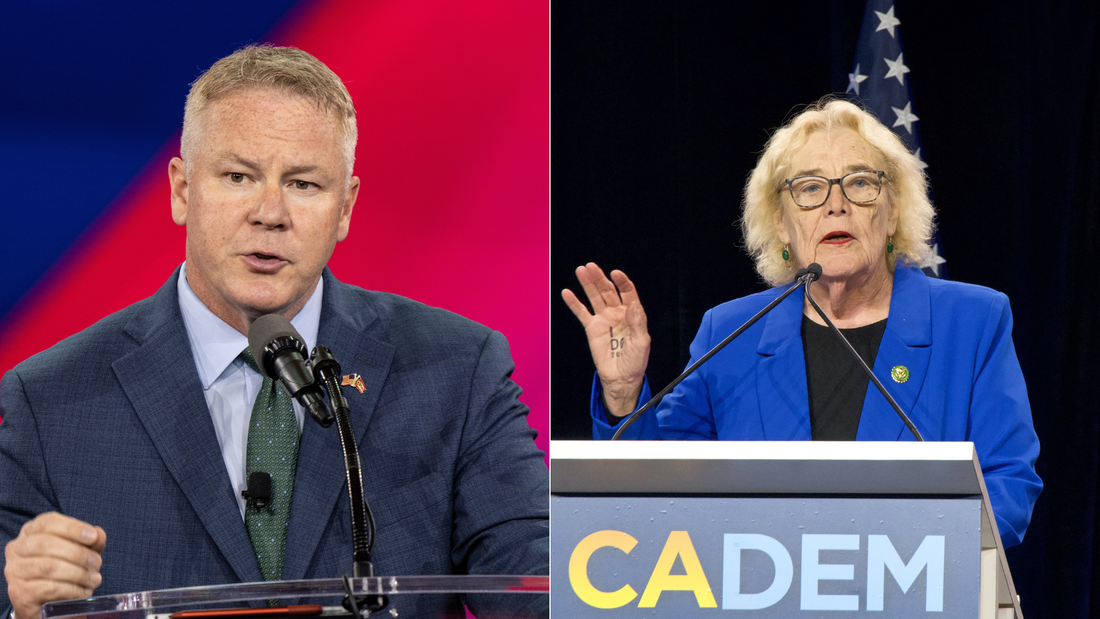
  • Rep. Warren Davidson (R-OH), who headed the successful effort to pass the Fourth Amendment Is Not For Sale Act through the House.
 
  • Rep. Chip Roy (R-TX), who succeeded in adding the regular reporting requirements on Section 702 inquiries by the FBI.
 
  • Rep. Andy Biggs (R-AZ), who stood tall in the House for adding warrants to Section 702 queries and came within one vote of winning.  
​
  • Rep. Ben Cline (R-VA), who succeeded in ending collection of surveillance of third-party mentions, or “abouts” information.

Other prominent and diligent House surveillance reformers include:
   
  • Rep. Sara Jacobs, (D-CA)
 
  • Rep. Tom Massie (R-KT)
 
  • Rep. Darrell Issa, (R-CA)

  • Rep. Zoe Lofgren, (D-CA)
​
In the Senate:

  • Sen. Dick Durbin, (D-IL) Chairman of the Judiciary Committee, stood up for warrants for Americans’ private communications.
 
  • In this effort Chairman Durbin had the strong, bipartisan support of Sen. Mike Lee (R-UT) and Sen. Ron Wyden (D-OR).
​
  • Sen. Rand Paul (R-KY) was a strong advocate for the Senate passage of the Fourth Amendment Is Not For Sale Act.

CONTRIBUTE TO OUR FIGHT TO PROTECT YOUR PRIVACY FROM GOVERNMENT SURVEILLANCE

House Passes Bill Forbidding Digital Currency Surveillance

5/24/2024

 
Picture
The House of Representatives on Thursday passed the CBDC Anti-Surveillance State Act, 216-192, a measure sponsored by House Majority Whip Tom Emmer (R-MN) that would prohibit the Federal Reserve from issuing a central bank digital currency (CBDC) that would give the federal government the ability to monitor and control individual Americans’ spending habits. 
 
“A digital dollar could give the FBI and other federal agencies instant, warrantless access to every transaction of any size made between Americans,” said Bob Goodlatte, former congressman and PPSA Senior Policy Advisor. “This would be an alarming and unacceptable invasion of our Fourth Amendment right to privacy. The CBDC Anti-Surveillance State Act takes a critical step to prevent this from happening. We applaud Rep. Emmer for his leadership in protecting Americans against pervasive government surveillance of our financial data.”
 
Perhaps next the House will consider measures to rein in financial surveillance by the U.S. Treasury and the Financial Crimes Enforcement Network (FinCEN). Passage by the House of the CBDC Anti-Surveillance State Act is an encouraging sign that more Members and their constituents are learning about the government’s financial surveillance and are ready to push back.

China Surveils and Punishes Students in U.S. Universities

5/21/2024


“You are being watched, and though we are on the other side of the planet, we can still reach you."

Picture
​Amnesty International released a report based on interviews with 32 Chinese students, including 12 from Hong Kong, studying in universities in eight countries – from the United States to Belgium, Canada, France, Germany, the Netherlands, Switzerland, and the United Kingdom.
 
Sarah Brooks, Amnesty International’s China Director, said that even when Chinese students study thousands of miles from home, many live in fear. “The Chinese authorities’ assault on human rights activism is playing out in the corridors and classrooms of the many universities that host Chinese and Hong Kong students,” she said.
 
A typical story was told by a student who attended a commemoration of the 1989 Tiananmen Square massacre. She was careful not to share her real name with anyone involved in the protest or to post anything online. Yet, a few hours later she heard from her father in China, who had been grilled by security officials. 
 
Such surveillance could possibly be performed by a quick study of online images. About one-half of Amnesty’s interviewees said they had been photographed or recorded at events by someone present at the protest. The only conclusion to draw from this is that China has enough spies in the United States and Western countries to show up and shadow protest events. Many students said they censor themselves online – even in the classroom – due to the perceived risk their comments and opinions will be reported. One-third of students said they changed the focus of their studies or dropped out of planned academic careers because of this pressure.
 
“Threats made to family members in mainland China included to revoke their passports, get them fired from their jobs, prevent them from receiving promotions and retirement benefits, or even limiting their physical freedom,” Amnesty reports. In some instances, families have been pressured to cut off financial support for their children.
 
More than one-half of the students interviewed said they suffered mental health issues linked to their fears, ranging from stress and trauma to paranoia and depression. One case led to hospitalization.
 
Western universities have been slow to recognize and counter these threats to students. Some academics have even sided with China against dissident students. Amnesty reports that a student was dropped by a Western university researcher on a project after learning that she had participated in a protest critical of China.
 
“The impact of China’s transnational repression poses a serious threat to the free exchange of ideas that is at the heart of academic freedom, and governments and universities must do more to counter it,” Brooks said.
 
Universities need to be fully aware of the threat of surveillance and retaliation against their students from China. The U.S. government must also take countermeasures to stop Chinese surveillance of students in the United States, even if this means expelling diplomats or tracking others who surveil and harass students exercising their right to free speech. We must also be aware of the dangers of purchased or posted data and videos that expose Chinese students to harm.
 
Amnesty’s report is a reminder that that in the United States, it is not just the U.S. federal government that surveils Americans and visitors to our shores.

Intel Community Must Reveal Case Behind the New “Make Everyone a Spy Law”

5/14/2024

 
Picture
​There is a mystery at the heart of the recently enacted law that broadens the definition of an “electronic communications service provider” with a duty to carry out secret surveillance at the request of the government.
 
Such compelled surveillance requirements were once focused on major companies, like Verizon, AT&T, and Google. But then came a secret case that led the intelligence community to want to expand the law to cover, well, almost everyone in business. This new law, increasingly known by its moniker “Make Everyone a Spy Act,” can now enlist business owners into copying the communications of their customers and handing them over to the FBI or some other government agency.
 
What prompted the intelligence community to want such a dramatic expansion of covered entities? Senate Intelligence Committee Chairman Mark Warner said on the Senate floor in April:
 
“Now, why has this suddenly now become such an issue? Well, one of those communications providers – remember I talked about clouds, data centers, how these networks come together and how network traffic is intertangled at these data centers? One of these entities that controlled one of those new enterprises that didn’t exist in 2008 said:
​

Well, hold it. You can’t compel us to work with the American government because we don’t technically fit the definition of an electronic communications service provider. And the fact was, the company that raised that claim won in court. So what happened was, the FISA Court said to Congress: You guys need to close this loophole; you need to close this and change this definition.”
 
Yet the new law is insanely broad. It covers “any” service provider with access to communications equipment. The government can now enlist custodial services, landlords, owners of small office complexes, gyms, dentist offices, and small businesses of almost every kind, as government spies. And, as with the larger telecoms and tech companies, these small businesses will be held under a gag order, preventing them from alerting their customers that they’ve been spied on.
 
Worse, because few small business owners have the ability to neatly parse exact threads of communications from their equipment, they will likely just turn over the equipment itself – and every customers’ private data it contains – to the NSA.
 
Little wonder that Sen. Ron Wyden (D-OR) described this sweeping provision as “one of the most dramatic and terrifying expansions of government surveillance authority in history.” Sen. Warner admitted that the provision “could have been drafted better.” He promised that if the Senate passed the bill, he would support a redraft of this law’s language in the next Intelligence Authorization Act or the National Defense Authorization Act. The Senate took him at his word and passed the bill.
 
But how can such a redraft be done without some guidance as to the nature of the case that prompted this new law?
 
Without a public disclosure of the type of service provider at the heart of the case Sen. Warner referred to, Congress cannot effectively narrow the language. The administration must declassify the type of provider in the FISC case to guide Congress in making precise refinements in its narrowing of the law.
 
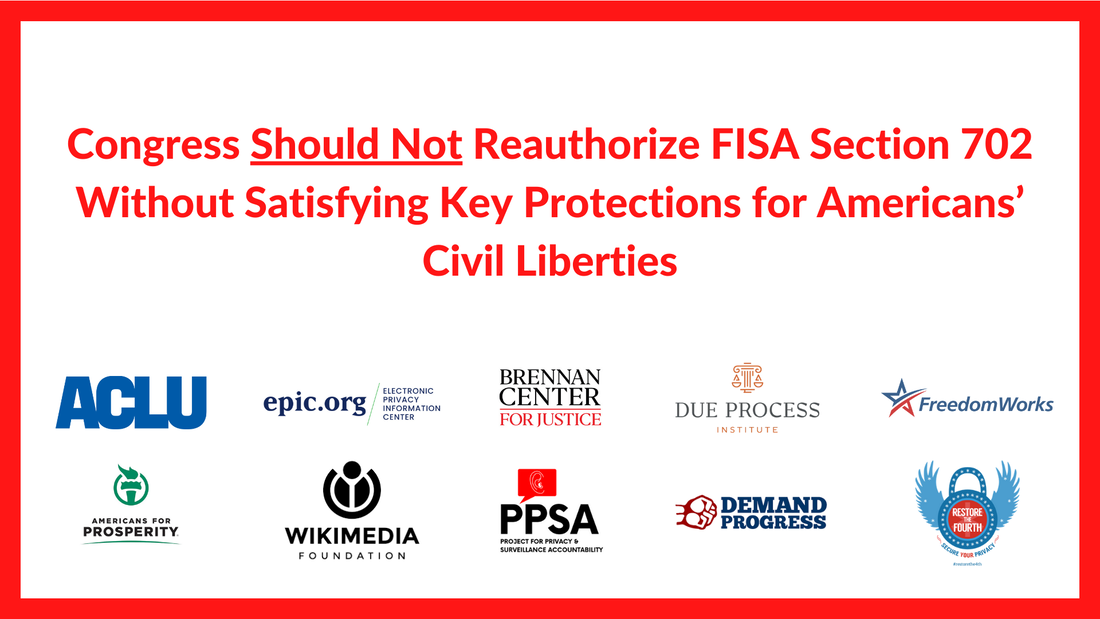
For that reason, PPSA is joining a host of civil liberties peer organizations – ranging from the American Civil Liberties Union and Brennan Center to the Due Process Institute and FreedomWorks – in an open letter to Attorney General Merrick Garland and Director of National Intelligence Avril Haines urging them to declassify the type of service provider at the heart of the FISC case.
 
The administration issued a written commitment to apply the new definition only to the type of provider at issue in the FISC decision. The recent history of American surveillance shows, however, that such commitments won’t bind future administrations. And time and again, we’ve seen one agency or another in the intelligence community resort to legal sophistry to break its word. 
 
Given that data centers were named by Sen. Warner on the Senate floor and even in a New York Times article, foreign spies are surely aware of the nature of the broad outlines of the case behind this new law. It is hard to imagine a stronger case for discretionary declassification. Disclosure must happen so Congress can curtail this new warrantless surveillance legislation in the narrowest way possible.

Surveillance Reform Wins and Losses After Section 702 Reauthorization

4/30/2024

 
Picture
​We needed a little perspective before reporting on the historic showdown on the reauthorization of FISA Section 702 that ended on April 19 with a late-night Senate vote. The bottom line: The surveillance reform coalition finally made it to the legislative equivalent of the Super Bowl. We won’t be taking home any Super Bowl rings, but we made a lot of yardage and racked up impressive touchdowns.
 
For years, PPSA has coordinated with a wide array of leading civil liberties organizations across the ideological spectrum toward that key moment. We worked hard and enjoyed the support of our followers in flooding Congress with calls and emails supporting privacy and surveillance reform.
 
So what was the result? We failed to get a warrant requirement for Section 702 data but came within one vote of winning it in the House. There was a lot of good news and new reforms that should not be overlooked. And where the news was bad, there are silver linings that gleam.

  • Best of all – and the intelligence community hates this – we succeeded in reducing the deadline for the next reauthorization of Section 702 from five years to two. We also got the date of reauthorization moved from the end of the year, when legislative priorities tend to get lost in the press of late business, to April in even (election) years.
 
  • An important reform amendment from Rep. Chip Roy (R-TX) passed. The FBI will now be under a microscope, with quarterly reports to Congress on the number of time the FBI searches, “or queries,” the communications of Americans in Section 702 databases. It also allows the leaders of both Houses of Congress and the House and Senate Judiciary and Intelligence Committees to attend hearings of the secret FISA Court.
 
  • The worst event of this round was that the “Make Everyone a Spy” amendment passed. Signed into law by President Biden, this measure allows the government to force a wide range of small businesses to help the NSA in its spying, and it gags them to prevent them from revealing it. This measure passed only after a pinkie promise from Attorney General Merrick Garland to enforce it narrowly. Sen. Mark Warner, Chairman of the Senate Select Committee on Intelligence, said he would support revising the bill’s vague language. Our coalition will closely watch the Department of Justice and take up Sen. Warner’s promise to tighten the language of this amendment. We will hold them to account.
 
  • Thanks to an amendment offered by Rep. Ben Cline (R-VA), we permanently ended “abouts” collection – the practice of surveilling Americans who are merely mentioned in a communication.
 
  • We secured dozens of reforms of the FISA process for both Section 702 and Title I surveillance, including:
 
  • The FBI can no longer rely on press reports or political opposition research to seek surveillance orders from the secret FISA Court.
 
  • The numbers of FBI personnel who can make Section 702 queries has been massively reduced, with independent audits of every U.S. person query.
 
  • FBI agents who lie to the FISA Court will be fired or suspended without pay. Leaking a secret FISA application will result in 10 years in prison and or a $250,000 fine. FBI personnel who lie to the FISA Court – as FBI lawyer Kevin Clinesmith did when he altered a document about Carter Page and submitted it as evidence – will face 10 years in prison and/or a $250,000 fine.
 

  • Soon after the Section 702 debate, the House passed The Fourth Amendment Is Not For Sale Act on a strong bipartisan 219-199 vote. This bill requires the FBI and other federal agencies to obtain a warrant before they can purchase Americans’ personal data, including internet records and location histories. Passage in the House gives a mark of validation to this bill, making it easier for the bill’s Senate champions to enlist their colleagues to support it.
 
We come out of this legislative fracas bloodied but energized. We put together a durable left-right coalition in which House Judiciary Committee Chairman Jim Jordan and Ranking Member Jerry Nadler, as well as the heads of the Freedom and Progressive caucuses, who worked side-by-side. For the first time, our surveillance coalition had the intelligence community and their champions on the run. We lost the warrant provision for Section 702 only by a tie vote. Had every House Member who supported our position been in attendance, we would have won. This bodes well for the next time Section 702 reauthorization comes up.
 
We will be ready.
 
Let’s not forget that a recent bipartisan YouGov poll shows that 80 percent of Americans support warrant requirements. We sense a gathering of momentum – and we look forward to preparing for the next big round in April 2026.

U.S. House Passes Fourth Amendment Not for Sale Act!

4/17/2024


PPSA Calls on Senate to End Data Purchases

Picture
​The House voted 219-199 to pass the Fourth Amendment Is Not For Sale Act, which requires the FBI and other federal agencies to obtain a warrant before they can purchase Americans’ personal data, including internet records and location histories.
 
“Every American should celebrate this strong victory in the House of Representatives today,” said Bob Goodlatte, former House Judiciary Chairman and PPSA Senior Policy Advisor. “We commend the House for stepping up to protect Americans from a government that asserts a right to purchase the details of our daily lives from shady data brokers. This vote serves notice on the government that a new day is dawning. It is time for the intelligence community to respect the will of the American people and the authority of the Fourth Amendment.”
 
Federal agencies, from the FBI to the IRS, ATF, and the Departments of Defense and Homeland Security, for years have purchased Americans’ sensitive, personal information scraped from apps and sold by data brokers. This practice is authorized by no specific statute, nor conducted under any judicial oversight.
 
“The Fourth Amendment Is Not For Sale Act puts an end to the peddling of Americans’ private lives to the government,” said Gene Schaerr, general counsel of PPSA. “Eighty percent of the American people in a recent YouGov poll say they believe warrants are absolutely necessary before their digital lives can be reviewed by the government. It is now the duty of the U.S. Senate to finish the job and express the will of the people.”
 
PPSA is grateful to Rep. Warren Davidson, House Judiciary Chairman Jim Jordan, Ranking Member Jerry Nadler, Reps. Andy Biggs, Rep. Pramila Jayapal, Rep. Zoe Lofgren, Rep. Thomas Massie, Rep. Sara Jacobs, and many others who worked to persuade Members to pass this bill in such a strong bipartisan victory.
 
Much of the credit also goes to PPSA’s followers, thousands of whom called and emailed Members of the House at a critical time.
 
“We will need you again when the Fourth Amendment Is Not For Sale Act goes to the Senate,” Schaerr said. “Stay tuned.”

Call Your U.S. House Rep Now and Say: “Vote for the Fourth Amendment Is Not For Sale Act”

4/16/2024

 
Picture
Our digital traces can be put together to tell the stories of our lives. They reveal our financial and health status, our romantic activities, our religious beliefs and practices, and our political beliefs and activities.
 
Our location histories are no less personal. Data from the apps on our phone record where we go and with whom we meet. Taken all together, our data creates a portrait of our lives that is more intimate than a diary.
 
Incredibly, such information is, in turn, sold by data brokers to the FBI, IRS, the Drug Enforcement Administration, the Department of Defense, the Department of Homeland Security, and other federal agencies to freely access. The Constitution’s Fourth Amendment forbids such unreasonable searches and seizures. Yet federal agencies maintain they have the right to collect and examine our personal information – without warrants.
 
A recent report from the Office of the Director of National Intelligence shows that:

  • Federal agencies collect bankruptcy information, employment history and income, credit histories, consumer purchase histories, and consumer interests.
 
  • Agencies acquire records about ethnicities, possible criminal records, voting registration, travel records, and attorney-client information.
 
  • Agencies purchase information about our medical and mental health, religious activities, browsing histories, and library records, communications with friends, expressions of political views, our associates, and details about our sex lives.
 
  • The authors of the report frankly admit that this information “could be used, for example, to identify every person who attended a protest or rally based on their smartphone location or ad-tracking records.”
 
  • Such information could be used to “facilitate blackmail, stalking, harassment, and public shaming.” 
 
The American people are alarmed. Eighty percent of Americans in a recent YouGov poll say Congress should require government agencies to obtain a warrant before purchasing location information, internet records, and other sensitive data about people in the U.S. from data brokers.
 
The Fourth Amendment Is Not For Sale Act now up for a vote in the House would prohibit law enforcement and intelligence agencies from purchasing certain sensitive information from third-party sellers, including geolocation information and communications-related information that is protected under the Electronic Communications Privacy Act, and information obtained from illicit data scraping. This bill balances Americans’ civil liberties with national security, giving law enforcement and intelligence agencies the ability to access this information with a warrant, court order, or subpoena.
 
Call your U.S. House Representative and say:
 
“Please protect my privacy by voting for the Fourth Amendment Is Not For Sale Act.”
CALL OR EMAIL YOUR US REP HERE

Friday’s Surveillance Honor Roll

4/12/2024

 
Picture
Pictured (Left to Right): Rep. Andy Biggs, Rep. Pramila Jayapal, Chairman Jim Jordan, Ranking Member Jerry Nadler, Rep. Zoe Lofgren, and Rep. Warren Davidson, .
​That a warrant requirement for Section 702 came within one vote of passing the House on Friday is a testament to the strong advocacy of its sponsors – Rep. Andy Biggs, Rep. Pramila Jayapal, Chairman Jim Jordan, Ranking Member Jerry Nadler, Rep. Warren Davidson, and Rep. Zoe Lofgren.
 
PPSA is also grateful to Rep. Chip Roy, who sponsored an amendment that requires the FBI to give Congress a quarterly report on the number of U.S. person queries conducted. This accountability measure, coupled with the shortening of the reauthorization of Section 702 from five years to two years, will greatly strengthen oversight of the FBI.
 
Further good news came from the passage of an amendment offered by Rep. Ben Cline, Rep. Jackson Lee, Rep. Andy Biggs, and Rep. Darrell Issa.  The House voted to permanently ban the intelligence practice of “abouts” collection in which Americans were targeted for merely being mentioned in a communication. Abuse of “abouts” collection prompted the FISA Court to publicly excoriate the National Security Agency for an “institutional lack of candor” about a “very serious Fourth Amendment issue.” Now the intelligence community will not be able to revive that measure.
 
Thanks to this bipartisan honor roll of surveillance reform champions, Congressional oversight will be strengthened, and the threat of “abouts” collection is history.

Photo Finish Loss for Section 702 Warrant Requirement But Reformers Succeed in Enhancing Oversight of FBI

4/12/2024

 
Picture
​An amendment to require the FBI and other federal agencies to obtain a probable cause warrant before accessing Americans’ communications under FISA Section 702 fell one vote short in the U.S. House of Representatives on Friday.
 
This was a disappointment, made worse by an expansion of the government’s surveillance powers contained in the bill. The House vote includes a change in the definition of an electronic communication service provider to require a whole new range of businesses to assist the government in its spying.
 
But there was also good news.
 
Pressure from reformers did succeed in changing Section 702 reauthorization from five years to two years. The House also passed a measure from Rep. Chip Roy (R-TX) that requires the FBI to give Congress a quarterly report on the number of U.S. person queries conducted. The combination of a shorter period before the next reauthorization and the strengthened oversight of the FBI should serve notice on the FBI and other agencies not to return to their lax treatment of Americans’ privacy and constitutional rights.
 
Reform received another win on Friday with the passage of an amendment sponsored by Rep. Ben Cline (R-VA) that makes permanent the suspended intelligence practice of “abouts” collection, in which Americans were targeted for merely being mentioned in a communications. Abuse of “abouts” collection prompted the FISA Court to publicly excoriate the National Security Agency for an “institutional lack of candor” about a “very serious Fourth Amendment issue.”
 
PPSA joins our civil liberties peers in calling on the Senate to reject any reauthorization that continues Section 702 programs without a warrant requirement for Americans. A recent YouGov poll shows that almost 80 percent of Americans support the warrant requirement. The signals for reform are growing stronger – the American people and a growing coalition in Congress have had enough of Washington’s surveillance abuse.

Your Calls and Emails Needed NOW to Reform FBI Domestic Surveillance

4/9/2024

 
Picture
The FBI and intelligence community on Friday secured a one-year certification to extend FISA Section 702. They did this in the full knowledge that the House was preparing to vote on the reauthorization of this surveillance authority.
 
But the struggle to end warrantless surveillance is far from over.
 
The House is still set to vote on Section 702 reauthorization – and that vote happens within hours. This is the moment when your voice can make a difference by urging your House Member to vote to impose warrant requirements for government surveillance of Americans’ data and communications.
 
Section 702 is an authority enacted by Congress to enable the surveillance of foreign targets on foreign soil but is now routinely used as a domestic surveillance program. Section 702 has been misused to spy on Members of Congress, a state judge, local political parties, journalists and 19,000 donors to a Congressional campaign. Little surprise, then, that recent polling by YouGov shows that 76 percent of Americans support a warrant requirement before the government can dip into Section 702’s global trawl of data to conduct backdoor searches on Americans.
 
“To use a secret court to unilaterally extend a mass spying program that has been so flagrantly abused by the government betrays the public’s trust and circumvents the proper role of Congress in this process,” said Kia Hamadanchy, ACLU senior policy counsel. Or as Rep. Warren Davidson reminds us, “Freedom surrendered is rarely reclaimed.”
 
Now is the time for you to forcefully defend the Constitution. Urge your House Member to stand fast today by voting for fundamental reforms to Section 702.
 
Please tell your House Member:
 
“Stop the FBI and other government agencies from spying on innocent Americans. Please vote to reform FISA’s Section 702 searches of Americans by adding a warrant requirement.”
ONE CLICK CALL HERE
ONE CLICK EMAIL HERE

What’s Lacking in the “Reforming Intelligence and Securing America” Act

3/26/2024

 
Picture
​The reform coalition on Capitol Hill remains determined to add strong amendments to Section 702 of the Foreign Intelligence Surveillance Act (FISA). But will they get the chance before an April 19th deadline for FISA Section 702’s reauthorization?
 
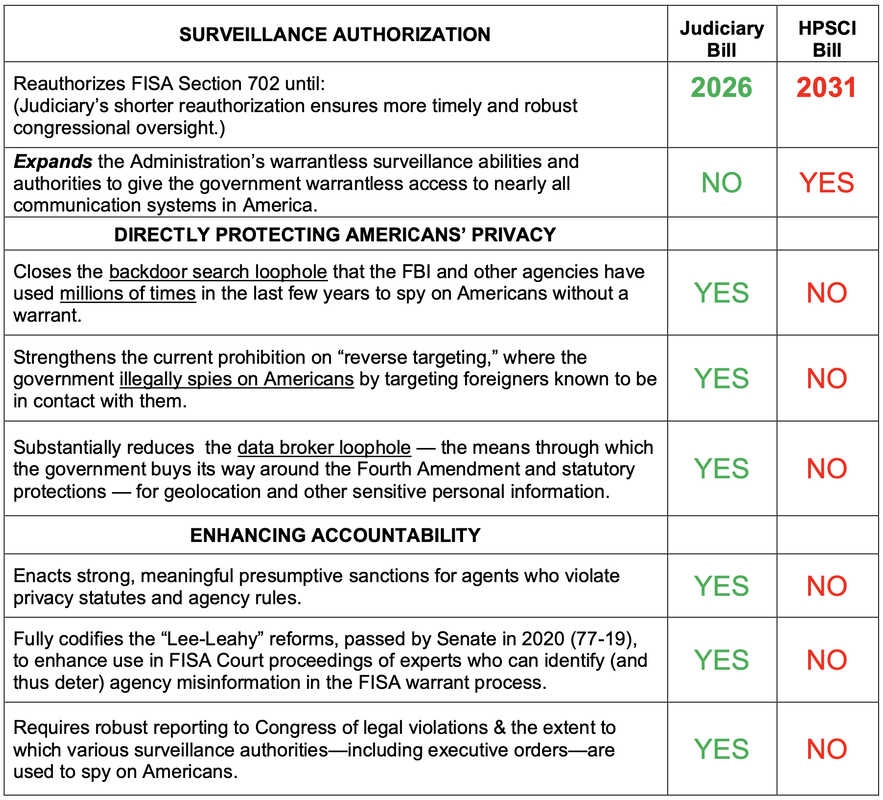
There are several possible scenarios as this deadline closes. One of them might be a vote on the newly introduced “Reforming Intelligence and Securing America” (RISA) Act. This bill is a good-faith effort to represent the narrow band of changes that the pro-reform House Judiciary Committee and the status quo-minded House Permanent Select Committee on Intelligence could agree upon.
 
But is it enough? RISA is deeply lacking because it leaves out two key reforms.
 
  • It excludes the principal reform of the House Judiciary Committee’s Protect Liberty and End Warrantless Surveillance Act – leaving intact the ability of the FBI and other agencies to continue to use Section 702 data to perform baseless searches on Americans. These searches have been performed on Members of Congress, 19,000 donors to a congressional campaign, and tens of thousands of protestors on the left and right. Reformers want a warrant before agencies can collect Americans’ communications, as the Fourth Amendment requires.
 
  • The bill does not close another loophole through which the FBI, IRS, Department of Homeland Security, and other federal agencies purchase and warrantlessly access the personal information of Americans. This data broker loophole gives the government access to Americans’ health, financial, romantic, religious, and political lives. If Congress cannot reform this practice with a warrant requirement, most other reforms will be meaningless.
 
The bill does include a role for amici curiae, specialists in civil liberties who would act as advisors to the secret FISA court. RISA, however, would limit the issues these advisors could address, well short of the intent of the Senate when it voted 77-19 in 2020 to approve the robust amici provisions of the Lee-Leahy amendment.
 
For all these reasons, reformers should see RISA as a floor, not as a ceiling, as the Section 702 showdown approaches. The best solution to the current impasse is to stop denying Members of Congress the opportunity for a straight up-or-down vote on reform amendments.

New Durbin-Lee Bill Offers Prospect Of Genuine Surveillance Reform

3/14/2024

 
Picture
Sen. Dick Durbin (D-IL) - pictured left, Chairman of the Senate Judiciary Committee, and fellow committee member Sen. Mike Lee (R-UT) - pictured right, today introduced the Security and Freedom Enhancement (SAFE) Act.
​The reauthorization of FISA Section 702, which allows federal agencies to conduct international surveillance for national security purposes, has languished in Congress like an old Spanish galleon caught in the doldrums. This happened after opponents of reform pulled Section 702 reauthorization from the House floor rather than risk losing votes on popular measures, such as requiring government agencies to obtain warrants before surveilling Americans’ communications.
 
But the winds are no longer becalmed. They are picking up – and coming from the direction of reform.
 
Sen. Dick Durbin (D-IL), Chairman of the Senate Judiciary Committee, and fellow committee member Sen. Mike Lee (R-UT), today introduced the Security and Freedom Enhancement (SAFE) Act. This bill requires the government to obtain warrants or court orders before federal agencies can access Americans’ personal information, whether from Section 702-authorized programs or purchased from data brokers.
 
Enacted by Congress to enable surveillance of foreign targets in foreign lands, Section 702 is used by the FBI and other federal agencies to justify domestic spying. According to the Foreign Intelligence Surveillance Act (FISA) Court, under Section 702 government “batch” searches have included a sitting U.S. Congressman, a U.S. Senator, journalists, political commentators, a state senator, and a state judge who reported civil right violations by a local police chief to the FBI. It has even been used by government agents to stalk online romantic prospects.
 
Millions of Americans in recent years have had their communications compromised by programs under Section 702. The reforms of the SAFE Act promise to reverse this trend, protecting Americans’ privacy and constitutional rights from the government. The SAFE Act requires:

  • Intelligence agencies to obtain an order from the FISA Court or a court order before accessing the contents of Americans’ communications collected under Section 702. In a nod to efficiency, warrants need not be obtained before the government runs queries of the data base. Given that less than 2 percent of Section 702 queries actually return results, this narrow requirement will greatly reduce the number of cases in which government agents must seek a warrant, leaving them free to focus on foreign intelligence for national security.
 
  • Generally prohibits collection of Americans’ purchased data. Federal agencies currently purchase Americans’ most sensitive, personal information – revealing details about our health, finances, romantic lives, religious worship, and political activities – from data brokers, without any specific statutory authorization. Intelligence agencies make up their own rules for these purchases of our information, without accounting for how and why they use it. The SAFE Act allows agencies to collect Americans’ data when it cannot be separated from other data purchases, but such data must be treated under minimization procedures. The bill otherwise closes this “data broker loophole” by requiring the government to get a court order to collect Americans’ data.
 
  • Strengthens the role of highly credentialed experts in privacy law as advisors to the FISA Court. People targeted by a surveillance request by the Department of Justice before this secret court are not represented – and are usually unaware – that they are targets. Such an amicus curiae would ensure that a legal expert with high-level security clearance would advise the court on the privacy and constitutional implications of surveillance requests.
 
  • Adds additional training for FBI personnel conducting Section 702 queries, while also requiring more managerial oversight of their queries, as well as audits, and regular reports of Section 702 activities to Congress. The Durbin-Lee bill requires approval from the FBI Deputy Director for any query involving a U.S. elected official, a U.S. state or political appointee, a U.S. political organization, or a member of such an organization. Similar approvals would be required involving religious organizations in any batch query. In this way, Durbin-Lee protects the First Amendment rights of how people vote, serve in office, and worship.
 
  • Strengthens the prohibition of “reverse targeting,” in which foreign surveillance can be used as a pretext to work backwards to justify spying on a domestic target.
 
  • Repeals the practice of “abouts” collection, currently suspended, in which the NSA collects second-hand mentions of a targeted person, rather than the communications of that actual person.
 
  • Imposes criminal penalties for knowingly submitting false information, or omitting relevant information, to the FISA Court. In the infamous Carter Page case, an FBI attorney gave the court a doctored document. Durbin-Lee would make the deliberate misleading of a court a specific crime.
 
Durbin-Lee is a pragmatic bill. It lifts warrants and other requirements in emergency circumstances. The SAFE Act allows the government to obtain consent for surveillance if the subject of the search is a potential victim or target of a foreign plot. It allows queries designed to identify targets of cyberattacks, where the only content accessed and reviewed is malicious software or cybersecurity threat signatures.
 
The SAFE Act is a good-faith effort to strike a balance between national security and Americans’ privacy. It should break the current stalemate, renewing the push for debate and votes on amendments to the reauthorization of Section 702.

How You Can Help End the Government’s Warrantless Surveillance of Your Personal Life

3/12/2024


Does the intelligence community have a secret veto?

Picture
​Time and again, the forces of the surveillance status quo have prevented Congress from voting on reforms of FISA Section 702 – the authority passed by Congress to allow the government to track foreign threats but has been used in recent years to surveil millions of ordinary Americans.
 
The intelligence community especially doesn’t want Congress to demand closure of the loophole that allows the government to purchase your most sensitive and personal information from data brokers. Federal agencies can use this data to accumulate a portfolio of your health and medical issues, personal life, financial concerns, religious beliefs and worship, and political posts and activities.
 
Repeated attempts by the U.S. House of Representatives to debate and hold a floor vote on these reform amendments to Section 702 have been stalled by legislative maneuvers and gamesmanship. At the same time, the government has applied to the FISA Court to extend Section 702 without reforms for a whole year, which could elbow Congress out of the policy process entirely.
 
While Congress struggles, a poll conducted by YouGov, commissioned by FreedomWorks and DemandProgress, show the American people – Republicans, Democrats, and independents – are paying attention and they do not like what they see:
​
  • Eighty percent of Americans agree that Congress should require government agencies to obtain a warrant before purchasing location information, internet records, and other sensitive data about people in the U.S. from data brokers.
 
  • Seventy-six percent agree that government agencies should be required to obtain warrants before intentionally searching international communications for conversations involving people in the U.S.

In the reauthorization of Section 702, Americans demand that Congress:

  • Close the loophole that allows international surveillance to become a platform to surveil Americans.
 
  • Close the loophole that allows government to purchase our sensitive, personal information from data brokers.

Members of Congress are now asking themselves: If I allow these domestic surveillance programs to continue, how am I going to explain this my constituents? You can help clarify this issue for your Member of Congress.
 
Tell your U.S. House Representative:
 
“Stop the FBI and other government agencies from spying on innocent Americans. Please fight for a vote to reform FISA’s Section 702 with warrant requirements, both for Section 702 data and for our sensitive, personal information sold to the government by data brokers.”
CALL YOUR REPS
EMAIL YOUR REPS

A Conservative’s Appeal to Speaker Johnson – Stop Any Maneuver to Curtail Debate on Section 702 Reforms

3/11/2024

 
Picture
​Ken Blackwell, former ambassador and mayor of Cincinnati, has a conservative resume second to none. He is now a senior fellow of the Family Research Council and chairman of the Conservative Action Project, which organizes elected conservative leaders to act in unison on common goals. So when Blackwell writes an open letter in Breitbart to Speaker Mike Johnson warning him not to try to reauthorize FISA Section 702 in a spending bill – which would terminate all debate about reforms to this surveillance authority – you can be sure that Blackwell was heard.
 
“The number of FISA searches has skyrocketed with literally hundreds of thousands of warrantless searches per year – many of which involve Americans,” Blackwell wrote. “Even one abuse of a citizen’s constitutional rights must not be tolerated. When that number climbs into the thousands, Congress must step in.”
 
What makes Blackwell’s appeal to Speaker Johnson unique is he went beyond including the reform efforts from conservative stalwarts such as House Judiciary Committee Chairman Jim Jordan and Rep. Andy Biggs of the Freedom Caucus. Blackwell also cited the support from the committee’s Ranking Member, Rep. Jerry Nadler, and Rep. Pramila Jayapal, who heads the House Progressive Caucus. Blackwell wrote:
 
“Liberal groups like the ACLU support reforming FISA, joining forces with conservatives civil rights groups. This reflects a consensus almost unseen on so many other important issues of our day. Speaker Johnson needs to take note of that as he faces pressure from some in the intelligence community and their overseers in Congress, who are calling for reauthorizing this controversial law without major reforms and putting that reauthorization in one of the spending bills that will work its way through Congress this month.”
 
That is sound advice for all Congressional leaders on Section 702, whichever side of the aisle they are on. In December, members of this left-right coalition joined together to pass reform measures out of the House Judiciary Committee by an overwhelming margin of 35 to 2. This reform coalition is wide-ranging, its commitment is deep, and it is not going to allow a legislative maneuver to deny Members their right to a debate.

PPSA Leads Reform Coalition to Warn Congress Against Attempts to Attach Section 702 Reauthorization to Any “Must-Pass” Spending Bill

2/29/2024

 
Picture
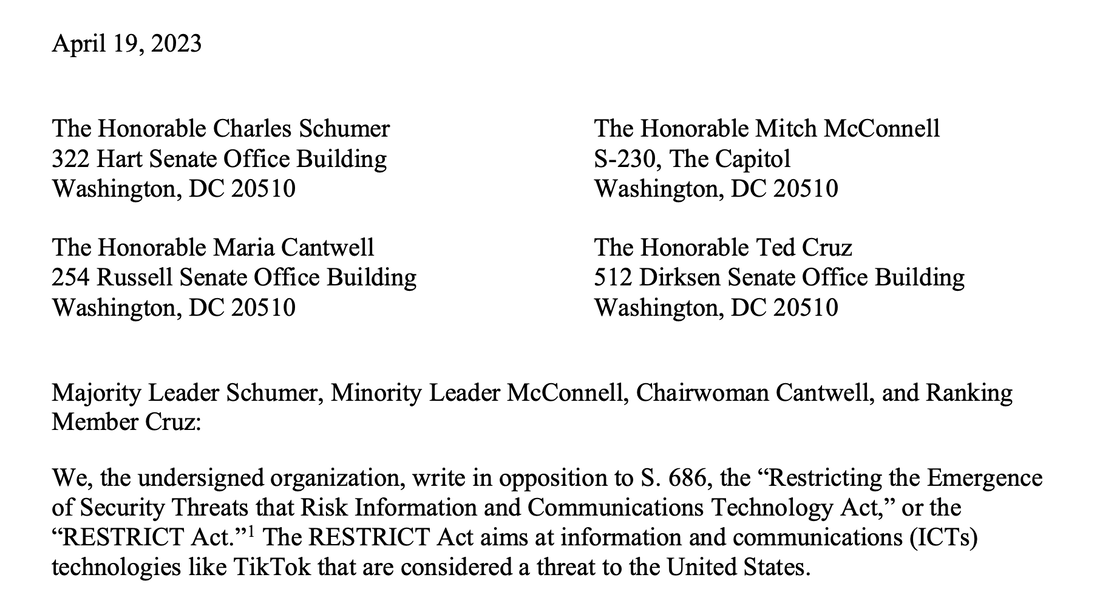
​PPSA, in concert with a coalition of major civil liberties groups from the left, right, and center, is appealing to Members of Congress “to oppose any legislative end-run that allows the FBI and other intelligence agencies to continue to spy on Americans without giving Congress the opportunity to vote on reforms.”
 
The word from Capitol Hill is that the intelligence community is now lobbying to attach a reauthorization of FISA Section 702 to a “must-pass” spending measure. Such a maneuver would cement the intelligence community’s strategy of denying Members of Congress a chance to have a debate and to vote on reforms to this surveillance authority.
 
Our letter, which includes Americans for Prosperity, the Brennan Center for Justice, Demand Progress, FreedomWorks, and the Wikimedia Foundation, warns Congress:
 
“The Fourth Amendment will become a constitutional dead letter if the government can continue to track our every movement, communications, where we worship, our financial and health issues, what we believe, and our political activity without warrants.”
 
Our letter concludes: “Congress must be able to vote on reforms rather than being faced with a ‘take-it-or-leave-it’ choice between funding the government and protecting Americans’ liberties.”
 
Our FISA Reform Coalition letter ended by urging Congress to stand up for Americans’ privacy, the Constitution, and against the insulting premise that Members of Congress should not be allowed to vote on surveillance reform.
<<Previous
Forward>>

    Categories

    All
    2022 Year In Review
    2023 Year In Review
    2024 Year In Review
    Analysis
    Artificial Intelligence (AI)
    Biometric Data
    Call To Action
    Congress
    Congressional Hearings
    Congressional Unmasking
    Court Appeals
    Court Hearings
    Court Rulings
    Data Privacy
    Digital Privacy
    Domestic Surveillance
    Facial Recognition
    FISA
    FISA Reform
    FOIA Requests
    Foreign Surveillance
    Fourth Amendment
    Fourth Amendment Is Not For Sale Act
    Government Surveillance
    Government Surveillance Reform Act (GSRA)
    Insights
    In The Media
    Lawsuits
    Legal
    Legislation
    Letters To Congress
    NDO Fairness Act
    News
    Opinion
    Podcast
    PPSA Amicus Briefs
    Private Data Brokers
    Protect Liberty Act (PLEWSA)
    Saving Privacy Act
    SCOTUS
    SCOTUS Rulings
    Section 702
    Spyware
    Stingrays
    Surveillance Issues
    Surveillance Technology
    The GSRA
    The SAFE Act
    The White House
    Warrantless Searches
    Watching The Watchers

    RSS Feed

FOLLOW PPSA: 
© COPYRIGHT 2026. ALL RIGHTS RESERVED. | PRIVACY STATEMENT
Photo from coffee-rank